
FAIL
A century-old photograph can sometimes catch technology at the exact moment it still seemed impossible.
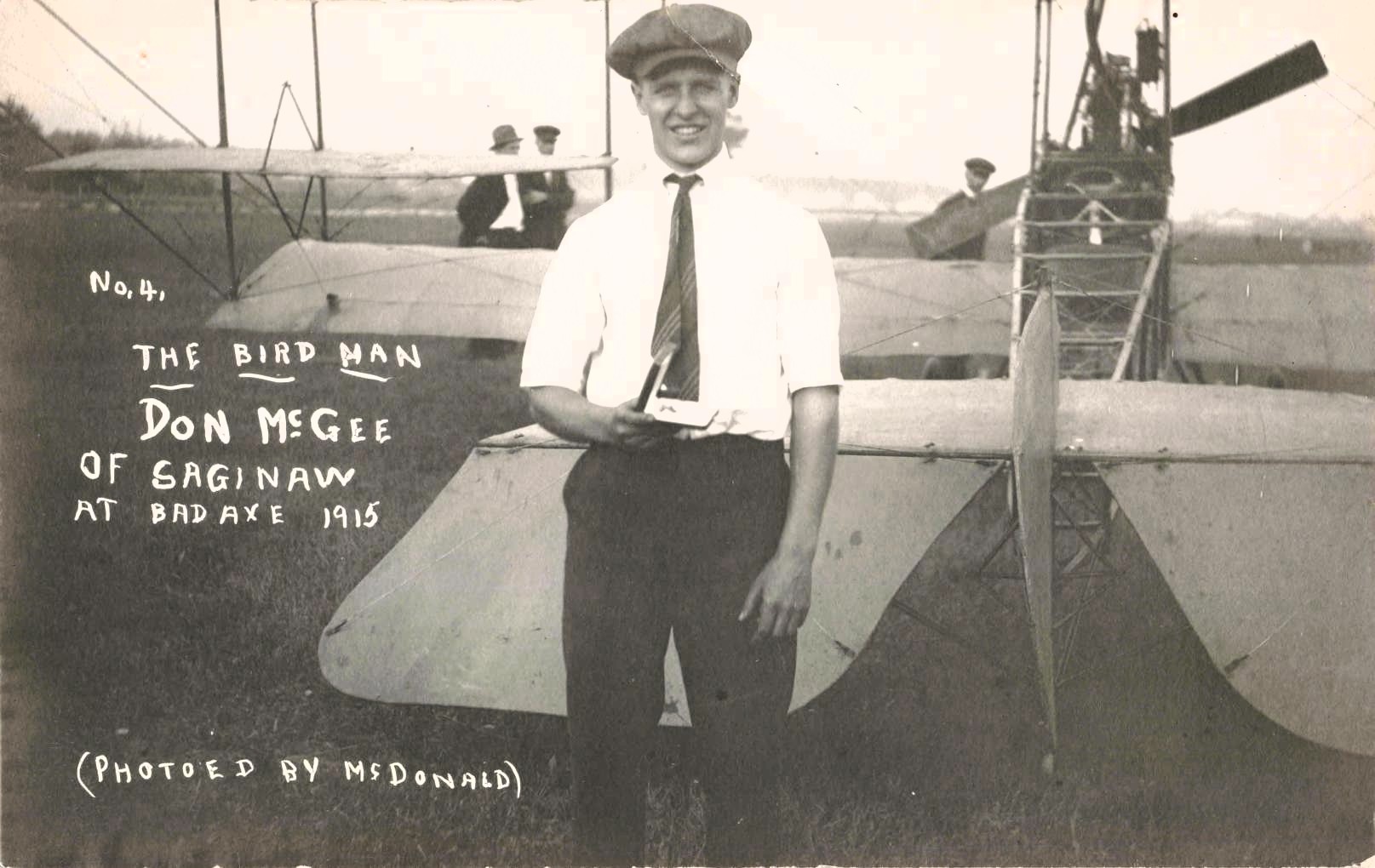
This image, dated 1915, shows a smiling young aviator standing beside an early biplane in Bad Axe, Michigan. Handwritten lettering identifies him as “The Bird Man — Don McGee of Saginaw.”
McGee was only 19 years old, but he was already helping to introduce powered flight to mid-Michigan.
Born in Cleveland in 1896, Donald McGee moved with his family to Saginaw when he was still young. According to accounts preserved by the Saginaw County Hall of Fame and aviation historians, his fascination with flight started early. He read about airplanes, experimented with gliders and eventually decided that reading about flying was not enough.
In 1915, McGee obtained airplane components left from an unsuccessful aircraft venture connected with Saginaw’s Brooks operation. Rather than simply assemble the machine as designed, he modified it. The resulting biplane used spruce, fabric, and a 60-horsepower Maximotor built in Detroit.
Then came the remarkable part.
McGee essentially taught himself to fly.
Accounts say he practiced in fields around Saginaw, first taxiing the machine and then making increasingly ambitious attempts to leave the ground. By June 1915, he was flying. The process sounds reckless by modern standards because it was. Aviation itself was barely more than a decade removed from the Wright brothers’ famous 1903 flight.
On Aug. 11, 1915, McGee made his first major public exhibition at the Harvest Festival in Merrill. Thousands reportedly watched as the young pilot climbed to roughly 1,000 feet, circled the area and returned safely.
Ten days later, on Aug. 21, McGee made the first airplane flight over the city of Saginaw, turning him into a local celebrity.
That brings us back to Bad Axe.
The photograph itself provides important evidence. Someone carefully wrote McGee’s name, Saginaw, Bad Axe, and the year 1915 directly onto the image. It places the young aviator in Michigan’s Thumb during the same season in which he emerged as a public flyer.
What the surviving caption does not tell us is the exact occasion. Without a newspaper notice or another record tied directly to this photograph, it would be risky to claim a particular fair, exhibition or flight.
What we can say is that McGee and an early aircraft were photographed in Bad Axe in 1915.
For residents of Huron County, such a sight would have represented startling technology. Automobiles were becoming more familiar, but airplanes remained rare enough that exhibition pilots could attract thousands simply by taking off, circling and landing.
Don McGee’s Flight Time Was Cut Short
McGee kept flying. During 1916, he used a larger airplane and continued making exhibition flights. When the United States entered World War I, he eventually became a civilian flight instructor at Selfridge Field near Lake St. Clair.
His promising career ended in 1917 when he died in an aircraft crash. He was only 21.
His life was remarkably short, but his place in Saginaw aviation history endured. A memorial scholarship was later established in his name.
And this photograph preserves another part of his story.
Before airports became common, before passenger airlines connected Michigan cities and before aircraft became an everyday sight overhead, a teenager from Saginaw stood beside his flying machine in Bad Axe.
Someone raised a camera.
And Michigan’s Bird Man smiled.
A century-old photograph can sometimes catch technology at the exact moment it still seemed impossible.
This image, dated 1915, shows a smiling young aviator standing beside an early biplane in Bad Axe, Michigan. Handwritten lettering identifies him as “The Bird Man — Don McGee of Saginaw.”
McGee was only 19 years old, but he was already helping to introduce powered flight to mid-Michigan.
Born in Cleveland in 1896, Donald McGee moved with his family to Saginaw when he was still young. According to accounts preserved by the Saginaw County Hall of Fame and aviation historians, his fascination with flight started early. He read about airplanes, experimented with gliders and eventually decided that reading about flying was not enough.
In 1915, McGee obtained airplane components left from an unsuccessful aircraft venture connected with Saginaw’s Brooks operation. Rather than simply assemble the machine as designed, he modified it. The resulting biplane used spruce, fabric, and a 60-horsepower Maximotor built in Detroit.
Then came the remarkable part.
McGee essentially taught himself to fly.
Accounts say he practiced in fields around Saginaw, first taxiing the machine and then making increasingly ambitious attempts to leave the ground. By June 1915, he was flying. The process sounds reckless by modern standards because it was. Aviation itself was barely more than a decade removed from the Wright brothers’ famous 1903 flight.
On Aug. 11, 1915, McGee made his first major public exhibition at the Harvest Festival in Merrill. Thousands reportedly watched as the young pilot climbed to roughly 1,000 feet, circled the area and returned safely.
Ten days later, on Aug. 21, McGee made the first airplane flight over the city of Saginaw, turning him into a local celebrity.
That brings us back to Bad Axe.
The photograph itself provides important evidence. Someone carefully wrote McGee’s name, Saginaw, Bad Axe, and the year 1915 directly onto the image. It places the young aviator in Michigan’s Thumb during the same season in which he emerged as a public flyer.
What the surviving caption does not tell us is the exact occasion. Without a newspaper notice or another record tied directly to this photograph, it would be risky to claim a particular fair, exhibition or flight.
What we can say is that McGee and an early aircraft were photographed in Bad Axe in 1915.
For residents of Huron County, such a sight would have represented startling technology. Automobiles were becoming more familiar, but airplanes remained rare enough that exhibition pilots could attract thousands simply by taking off, circling and landing.
Don McGee’s Flight Time Was Cut Short
McGee kept flying. During 1916, he used a larger airplane and continued making exhibition flights. When the United States entered World War I, he eventually became a civilian flight instructor at Selfridge Field near Lake St. Clair.
His promising career ended in 1917 when he died in an aircraft crash. He was only 21.
His life was remarkably short, but his place in Saginaw aviation history endured. A memorial scholarship was later established in his name.
And this photograph preserves another part of his story.
Before airports became common, before passenger airlines connected Michigan cities and before aircraft became an everyday sight overhead, a teenager from Saginaw stood beside his flying machine in Bad Axe.
Someone raised a camera.
And Michigan’s Bird Man smiled.