The proposed Safeguard American Voter Eligibility (SAVE) Act is being promoted as an election integrity measure. Supporters say it would require proof of U.S. citizenship to register to vote in federal elections. Critics say it could disenfranchise millions. But there is another issue that has received far less attention: married women who changed their last names.
By some estimates, as many as 146 million Americans could be affected by new documentation requirements tied to citizenship and voter registration records. The central issue is documentation. Many Americans do not have passports. Many rely on birth certificates. And that is where a major social complication appears.
A birth certificate lists a person’s name at birth. For millions of married women, that name no longer matches their legal name. In most cases, a woman who takes her husband’s last name does not receive a new birth certificate. Instead, her legal name change is documented through a marriage license and Social Security records.
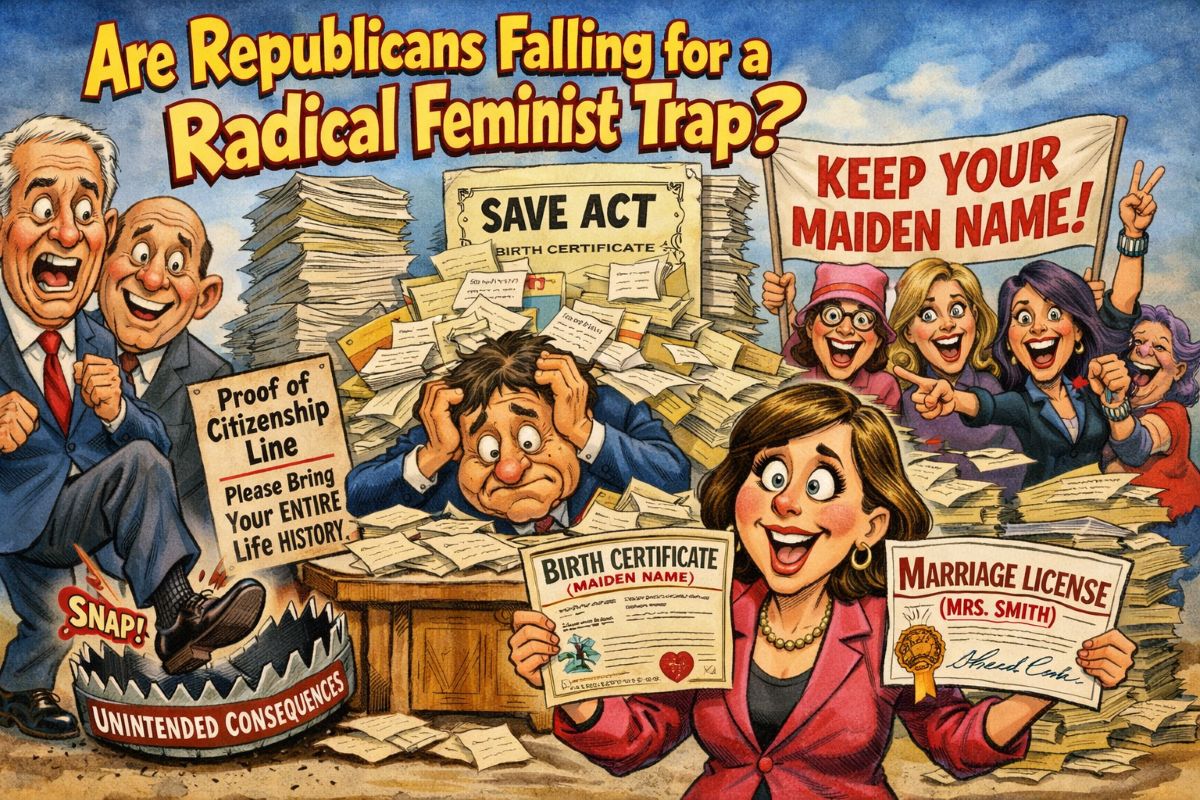
If the SAVE Act requires a birth certificate that matches a current legal name, then a married woman may need to present multiple documents: a birth certificate, a marriage license, and possibly additional identification. That creates a higher documentation burden for married women than for men or unmarried women whose names match their birth records.
This raises a serious question: Did lawmakers fully think through the real-world paperwork problem this creates?
A Documentation Gap That Affects Women Disproportionately
This is not a small group. According to census and survey data, a large majority of married women in the United States have historically taken their husband’s last name. That means tens of millions of voters could face extra steps to prove identity and citizenship under stricter documentation rules.
In practical terms, this means:
- A man brings a birth certificate that matches his name.
- A married woman may need a birth certificate plus a marriage certificate.
- If she were married more than once, she may need multiple marriage and divorce records.
That is not a minor administrative detail. That is a structural difference in how the law affects men and women.
An Unintended Social Consequence
Here is where the issue becomes politically ironic.
For decades, some feminist advocates argued that women should keep their maiden names after marriage for identity, professional, and legal reasons. Many conservatives opposed that cultural shift, emphasizing traditional naming practices.
But if the SAVE Act makes voting more complicated for women who change their names, the law could unintentionally encourage women to keep their maiden names to avoid documentation problems.
In other words, a law promoted by conservative lawmakers to secure elections could end up reinforcing a social outcome long supported by feminists: women keeping their birth names.
That may not have been the intention, but it is a logical outcome if documentation requirements become strict and complicated.
The Real Question
The core policy question is not whether election integrity matters. It does. The real question is whether lawmakers understand how documentation laws interact with real life — marriage, divorce, name changes, and missing records.
Laws written on paper often look simple. Laws applied to 330 million people are not simple.
If the SAVE Act becomes law, election officials may spend years dealing with paperwork issues tied not to fraud, but to name changes.
And that raises a final question lawmakers should answer clearly:
Should a woman have to prove every name she has ever had in order to vote?
Because if the answer is yes, then the social impact of this bill may be much larger — and very different — than its supporters expect.